Vermont Gov. Phil Scott promised not to raise taxes, but he is now presiding over the largest property tax increase in memory. What happened? Gov. Scott says that schools spend too much. But Rep. Dave Sharpe, chair of the Vermont House Education Committee and a former teacher, dismisses this charge and says the tax hike was brought on by Scott’s policies. Sharpe also discusses new plans for how to fund education, and expresses skepticism about the governor’s proposal to provide free college to members of the Vermont National Guard — and no one else. (February 7, 2018 broadcast)
Rep. Dave Sharpe, chair, Vt House Committee on Education
The U.S. earned its only Olympic medal in cross-country skiing in 1976, when Vermont skier Bill Koch captured silver. That may soon change: The women of the US cross-country ski team are serious contenders for an Olympic medal in South Korea in 2018. [Note: On Feb. 21, 2018, Jessie Diggins & Kikkan Randall won an Olympic gold medal in cross-country skiing, the first ever for Americans in this sport.]
In this Vermont Conversation, and author, coach and skiers discuss the remarkable rise of the US women’s cross-country ski team from being perennial back-of-the-pack finishers to winning numerous medals in world championship races. Author Peggy Shinn says it “attests to the power of a transformational leader, a coach who connects with his athletes, the super-fast individual skiers who are also conscientious teammates–and a bit of good luck.” (January 31, 2018 broadcast)
On January 23, 2018, Vermont Attorney General T.J. Donovan issued a statement strongly opposing a plan by Gov. Phil Scott to build a $140 million 925-bed private prison in Vermont. “Vermonters should ask some tough questions about whether there is a better way to address the need for correctional facilities in the state of Vermont,” wrote Donovan. Attorney General Donovan explains why he has taken the unusual step of coming out strongly and early against the governor’s plan. “I hope his leadership on this issue can be replicated nationally,” responded ACLU deputy director Bill Cobb. (January 24, 2018 broadcast)
Vermont Attorney General T.J. Donovan
James Lyall, executive director, ACLU of Vermont
Bill Cobb, deputy director, ACLU Campaign for Smart Justice
Ashley Sawyer, Vermonters for Criminal Justice Reform, formerly incarcerated
According to the ACLU, Vermont currently incarcerates approximately 1,700 people. That’s three times the number of people it incarcerated in the 1980s and 50 percent more people than in the late 1990s. According to the Sentencing Project, Vermont imprisons Black men at a higher rate than any other state. All this comes at great cost: the FY17 budget for the Department of Corrections was $142 million.
On January 24, 2018, the ACLU of Vermont launched Smart Justice Vermont. This is part of the National ACLU’s Campaign for Smart Justice that was launched in 2014 with a goal of cutting the national prison population of 2.3 million people in half. We discuss how Vermont, and the US, can take concrete steps to end mass incarceration. Cobb also discusses his experience being incarcerated in Pennsylvania. (January 24, 2018 broadcast)
James Lyall, executive director, ACLU of Vermont
Bill Cobb, deputy director, ACLU Campaign for Smart Justice
The Post is a new Hollywood movie about the dramatic decision by the Washington Post (together with the NY Times) to publish the Pentagon Papers in 1971. The movie features Tom Hanks and Meryl Streep. The real-life star of this drama was Daniel Ellsberg, who leaked the top-secret history of the Vietnam War to the newspapers. Ellsberg was a former Marine and adviser on the Vietnam War to Presidents Johnson, Nixon and Secretary of State Henry Kissinger. The Pentagon Papers revealed that top US government officials had been lying about the Vietnam War to the American people.
For leaking the Pentagon Papers, Ellsberg was charged with theft, conspiracy and violations of the Espionage Act, but his case was dismissed as a mistrial when evidence surfaced about the government-ordered wiretaps of his phone and break-ins of his psychiatrist’s office.
Daniel Ellsberg is now 86 years old and remains active in the peace movement. I interviewed Ellsberg in 2015, when this originally aired on the Vermont Conversation. (January 17, 2018 broadcast)
State treasurers are not typically viewed as crusaders for economic justice. But Vermont State Treasurer Beth Peace has quietly and doggedly championed programs, some of them first-in-the-nation, aimed at strengthening the economic security of working people. She pushed for passage of one of the broadest public retirement programs in the country, Green Mountain Secure Retirement, which will enable small businesses to offer retirement plans to over 100,000 employees. She also oversees a statewide local investment program, under which the Vermont State Treasurer invests 10 percent of its cash reserves into local initiatives. In December 2017, Vermont Businesses for Social Responsibility gave Pearce its Public Servant of the Year Award “for her work to establish a public retirement system, clean up Vermont’s waterways, and to address the impacts of climate change through state investments.”
Pearce, 1 of just 9 female State Treasurers in the U.S., is serving her fourth term as Treasurer after being appointed to the position in 2011. She is the newly elected President of the National Association of State Treasurers. (January 10, 2018 broadcast)
Vermont Sen. Becca Balint and Rep. Kiah Morris are political trailblazers. Balint, the Senate Majority Leader, is one of the first women to be elected to Senate leadership and the highest ranking openly gay legislator in the state. Morris is just the second African American woman to serve in the Vermont legislature. In separate interviews, the two leaders talk about the “sea change” for women in politics in the wake of the #MeToo movement against sexual harassment, how they mix activism, advocacy and politics, and their personal journeys into politics. (January 3, 2018)
Vt. Senator Becca Balint, Windham County, Senate Majority Leader
A rare meeting of two icons: Bill McKibben, author, activist and founder of 350.org, and Ken Squier, owner of WDEV Radio Vermont and a legendary sports broadcaster who will be inducted into the NASCAR Hall of Fame in January 2018, held a public conversation moderated by Vermont Conversation host David Goodman on December 6, 2017 at Bridgeside Books in Waterbury, Vermont. McKibben’s latest book, Radio Free Vermont: A Fable of Resistance, is a story about a septuagenarian radio man and his people-powered independent radio station that lead a resistance movement against growing government tyranny. McKibben acknowledges that Squier and WDEV provide the inspiration for this fable. Squier has been an outspoken advocate of independent media and McKibben is a longtime fan of WDEV (and an occasional guest) when not traveling the world leading the movement to halt climate change. The two discuss the world under Trump, the vital role of an independent media, and the way forward. (December 27, 2017 broadcast)
Bill McKibben, author, founder of 350.org
Ken Squier, owner, WDEV Radio Vermont, legendary sports broadcaster, NASCAR Hall of Fame 2018
Stuart Stevens has been a top Republican strategist in the presidential election campaigns of Mitt Romney and George W. Bush. But Stevens has been a vocal critic of President Donald Trump and now describes himself as “homeless” in his own party. He talks about why he wrongly predicted Trump could not win, how Trump has used racism as a core strategy, why fellow Republicans have backed him, and how the GOP has “lost its soul.” Trump has tweeted that Stevens is a “dumb guy” and a “clown.” An author of seven books, Stevens, a part-time Vermont resident, also discusses growing up in Mississippi and his book about spending a season watching football with his 95 year old father. (December 20, 2017 broadcast)
Matt Lauer of NBC, Charlie Rose, of PBS and CBS, Bill O’Reilly of Fox News, John Hockenberry of NPR – all of these powerful men of the media have one thing in common: they no longer have a microphone due to sexual harassment allegations. Are these men getting their just due, or being denied due process and unfairly punished? For answers, we turned to Madhulika Sikka, the public editor of PBS, where serves as an independent internal critic of the network. Prior to joining PBS, she was the award-winning executive producer of NPR’s Morning Edition, executive editor of NPR News, and worked at ABC News Nightline with Ted Koppel for 13 years. Sikka recently argued in an article in The Daily Beast: “Stop lamenting the ‘loss of talent’ of the men who have been removed. If we examine the lost opportunities of so many women as a result of the structural obstacles to their growth, advancement, and power, that work could fill up all our time.” Sikka discusses the fall of the media’s mighty men, her book about dealing with breast cancer, and her latest project, 52 weeks 52 books 52 women, a website and podcast. (December 13, 2017 broadcast)
Journalist-turned-historian Mark Bushnell has been writing about Vermont history since 2002 for the Rutland Herald, Barre-Montpelier Times Argus and VTDigger. His latest book, Hidden History of Vermont (History Press, 2017), takes a new look at some old stories. He questions whether Ethan Allen, leader of the fabled Green Mountain Boys during the American Revolution, was the war hero he is said to be. Bushnell also explores how Vermont missed the chance to give women the vote, and it’s key role opposing Sen. Joe McCarthy. We revisit these and other hidden bits of Vermont history. (December 13, 2017 broadcast)
Mark Bushnell, historian and author, Hidden History of Vermont
Vermont’s local food movement is a national leader. There are ambitious goals: the Vermont Farm to Plate plan calls for 10% local food consumption by 2020, while the New England Food Vision aims for 50% of all food consumed in New England to be from local sources by 2050. But we have a long way to go: Currently just 7% of Vermont’s food is sourced locally. We discuss the history and future of the local food movement, and a new documentary series on Vermont PBS, The Local Motive.(December 6, 2017 broadcast)
A new report, Billionaire Bonanza 2017, shows that the three wealthiest Americans — Jeff Bezos of Amazon, Bill Gates of Microsoft, and investor Warren Buffet — have more wealth than the bottom half of all U.S. households combined. “If left unchecked, wealth will continue to accumulate into fewer and fewer hands,” says Josh Hoxie, report co-author. “The time to reverse this trend is past due.” Hoxie, a former staffer for Vt. Sen. Bernie Sanders, is director of the Project on Opportunity and Taxation at the Institute for Policy Studies and co-editor of Inequality.org. He discusses America’s new oligarchy, how the 2017 Republican tax overhaul will rob the middle class to pay the rich, and how citizens can push back. (November 29, 2017 broadcast)
Terri Hallenbeck started work for the BurlingtonFree Press in 1998, where she served as copy editor and assistant metro editor. She joined the paper’s capital bureau from 2005 to 2014, when she left to join Seven Days, where she was the staff writer covering state politics until November 2017, when she left journalism to work for Middlebury College. She talks about the gubernatorial campaigns she has covered, how she persuaded Gov. Peter Shumlin to give her a final interview, her experience reporting one of the first stories about a patient who used Vermont’s death with dignity law, and the changing face of journalism in Vermont. (November 29, 2017 broadcast)
“If you want the American Dream, go to Finland,” said British politician Ed Miliband. This is the premise behind Finnish journalist Anu Partanen’s book, The Nordic Theory of Everything: In Search of a Better Life. Partanen discusses what the U.S. can learn from Finland about love, taxes, education, and happiness. She describes how Finnish mothers receive 10 months of paid maternity leave, how Finnish schools lead the world in quality and performance, and how Finnish people are happier by many measures — all for a similar level of taxation as middle-class Americans. Finally, she reflects on how she will pass on these Nordic values to her newborn daughter, an American citizen. (November 15, 2017 broadcast)
Anu Partanen, author, The Nordic Theory of Everything: In Search of a Better Life
Reuben Jackson has been the host of Friday Night Jazz on Vermont Public Radio since 2012, a job he has just announced that he will leave in 2018. Before this, he was curator of the Duke Ellington Collection at the Smithsonian in Washington, D.C. for 20 years. Jackson is also an accomplished poet and an educator with the Young Writers Project. Jackson discusses his poetry, jazz, and his experience as an African American in one of America’s whitest states. He also reads his poem, “For Trayvon Martin.” (November 8, 2017 broadcast)
Sarah Browning is co-founder and executive director of Split This Rock: Poetry of Provocation & Witness, and an Associate Fellow of the Institute for Policy Studies. She talks about poetry as protest, white supremacy and privilege, her work organizing poets, and the annual Split This Rock poetry festival. She also reads from her new collection of poetry, Killing Summer. (November 8, 2017 broadcast)
Could an aging Vermont radio man, aided by a crew of Olympic cross-country skiers and craft-beer drinking fellow travelers, lead the resistance to Donald Trump? That’s the plot of Radio Free Vermont: A Fable of Resistance, the latest book by author and activist Bill McKibben. The central character of McKibben’s first novel bears an uncanny resemblance to Ken Squier, the legendary owner and broadcaster of WDEV, the independent radio station that he and his late father have run since 1931 (on which the Vermont Conversation airs). “This is James Bond meets A Prairie Home Companion, and no one but Bill McKibben could pull it off,” writes author Naomi Klein.
McKibben is the founder of the grassroots global climate change organization 350.org and author of a dozen books, including The End of Nature, Enough: Staying Human in an Engineered Age, and Deep Economy. He talks here about resistance–fictional and real–how he has been personally targeted by the fossil fuel industry, why craft beer matters, and his recent travels to Alaska and Africa in search of climate solutions and sanity. (November 1, 2017 broadcast)
Vermont’s lone nuclear power plant, Vermont Yankee, operated from 1972 until 2014, when the plant shut down for good under intense political and financial pressure. POWER STRUGGLE is a new feature-length documentary by filmmaker Robbie Leppzer about the political battle to close Vermont Yankee. We speak with Leppzer and Arnie & Maggie Gundersen, key figures in the VY battle, about the story of how nuclear power ended in Vermont, the after-effects of the 2011 nuclear meltdown in Fukushima, Japan, and the future of nuclear power. (October 25, 2017 broadcast)
Robbie Leppzer, award-winning independent documentary filmmaker, Power Struggle
Arnie Gundersen, nuclear engineer and whistleblower
Rob Miller wanted to shake things up: the president and CEO of Vermont State Employees Credit Union (VSECU) wanted to make his company more transparent. And he wanted to be more responsive to customers. First, he had to change the business culture. He talks about how you pursue passion and purpose and change the culture in “unexpected places.” (October 25, 2017 broadcast)
The #MeToo campaign, in which women are taking to social media to share their experiences with sexual harassment and assault, has shined a bright light on what women deal with daily at work and in public. This campaign has been energized by revelations about how Hollywood mogul Harvey Weinstein routinely sexually assaulted, touched and humiliated countless women. Two experts discuss what sexual harassment is, their personal and professional experiences with it, and how women can fight back. (October 18, 2017 broadcast)
Pres. Trump insists the media is “terribly unfair” to him. Is it? Jesse Holcomb, formerly of the Pew Research Center and currently a professor of journalism at Calvin College, dissects media coverage of Trump, and delves into the quality of news articles on the right and left. He also explores the influence of far-right Breitbart News and its affiliates. Holcomb’s research finds that fewer than half of news stories about Trump for right-leaning audiences cite more than a single source, while 70 percent of stories for left-leaning audiences cite multiple sources. Holcomb says that the media “needs to take a look in the mirror” at how it has contributed to the rise of Trump. (October 18, 2017 broadcast)
Jesse Holcomb, Calvin College, Columbia Journalism School’s Tow Center for Digital Journalism, Pew Research Center
In 2013, the first all-African American team of climbers tackled Denali, or Mt. McKinley, in Alaska, North America’s highest peak. The expedition was sponsored by the National Outdoor Leadership School (NOLS). The goal of the expedition was to inspire minority communities to look outdoors for enriching experiences and to encourage environmental stewardship. James Edward Mills, who was part of the expedition, is the author of The Adventure Gap: Changing the Face of the Outdoors, which explores how minority populations view their place in wild environments. Mills is a journalist and media producer and maintains the blog and podcast The Joy Trip Project (joytripproject.com). He has worked in the outdoor industry since 1989 as a guide, outfitter, independent sales representative, and writer. Mills is also co-producer of a film about the climb, An American Ascent. (October 11, 2017 broadcast)
James Edward Mills, author, The Adventure Gap: Changing the Face of the Outdoors
Co-working is what independent workers do who share an office but not a job. Vermont has seen a variety of co-working spaces pop up from Bennington to Burlington. They serve telecommuters, freelancers, and independent entrepreneurs. We speak with leaders of several Vermont co-working spaces. (October 4, 2017 broadcast)
As the world refugee crisis swells, Pres. Donald Trump has capped the number of refugees that the U.S. will accept at 45,000 — the lowest level since the refugee resettlement program was established 37 years ago. In 2016, Pres. Obama set the cap at 110,000. Trump calls it the “America First Refugee Program,” evoking the name of the openly anti-Semitic WWII-era America First Committee. Mark Hetfield is president and CEO of HIAS, which was founded as the Hebrew Immigrant Aid Society in 1881. HIAS is the world’s oldest organization dedicated to refugees. Hetfield has led the transformation to a global agency that assists and resettles refugees of all faiths and ethnicities and is a major implementing partner of the United Nations Refugee Agency and the U.S. Department of State. In February 2017, under his leadership, HIAS became the first and only national refugee resettlement agency to file a court challenge against the Trump Administration and its executive order implementing a Muslim and refugee ban, a challenge which led to an injunction against the order. He discusses the impact of Trump’s refugee bans and his reaction to the protest movement that rose up to challenge Muslim bans. (September 27, 2017 broadcast)
Bestselling author, activist and filmmaker Naomi Klein is known for her critical writings on corporate globalization and capitalism. Her books include No Logo (1999), The Shock Doctrine:The Rise of Disaster Capitalism (2007) and This Changes Everything: Capitalism Versus the Climate (2014). Her newest book is No Is Not Enough: Resisting Trump’s Shock Politics and Winning the World We Need (Haymarket, 2017), has been nominated for a National Book Award. In our interview, Klein discusses climate catastrophes, the rise of Trump, what Democrats and have done wrong, and resistance. (September 20, 2017 broadcast)
Naomi Klein, author, No Is Not Enough: Resisting Trump’s Shock Politics and Winning the World We Need
Today’s movements celebrating slow food and simple living owe a debt to food writer Patience Gray. In 1986, she published Honey from a Weed, considered one of the greatest cookbooks of all time by the likes of Mollie Katzen and April Bloomfield, and she has influenced culinary trailblazers like Alice Waters. For more than 30 years, Gray lived without electricity, modern plumbing, or a telephone in remote area in southern Italy. She grew much of her own food and also foraged. In the new book, Fasting and Feasting: The Life of Visionary Food Writer Patience Gray (Chelsea Green, 2017), Vermont author Adam Federman shares Gray’s fascinating and trailblazing life with a generation that may not know her name, but has been influence by her ideas. (September 20, 2017 broadcast)
Adam Federman, author, Fasting and Feasting: The Life of Visionary Food Writer Patience Gray
Juan González is one of the best known Latino journalists in the U.S. He has been a crusading columnist for the New York Daily News for nearly 30 years, co-host of Democracy Now! for 20 years, and is now a professor of journalism at Rutgers. His books include Harvest of Empire: A History of Latinos in America and News for All the People: The Epic Story of Race and the American Media (with Josph Torres). In his newest book, Reclaiming Gotham: Bill de Blasio and the Movement to End America’s Tale of Two Cities, González gives an inside account of the unlikely rise of a little-known progressive politician who stunned the political elite and was elected mayor of New York in 2013, and re-elected in a landslide in September 2017. González says that de Blasio is part of a nationwide revolt of cities against neoliberal, corporate-dominated state and national politics, and represent a powerful counterforce to President Donald Trump. (September 13, 2017 broadcast)
Juan González, journalist and author, Reclaiming Gotham
Peter Gould has been involved in Vermont arts as a performer, director, teacher, and author for more than 45 years. He is the founder of “Get Thee to the Funnery,” a youth Shakespeare program in Craftsbury, Vt. which celebrated its 20th season in 2017. As half of Gould & Stearns — a 2 man touring theater company — Peter traveled throughout the country and internationally, performing more than 3,000 performances, including their original play, “A Peasant of El Salvador.” Peter received a B.A. and Ph.D from Brandeis University, where he is currently an adjunct professor at Brandeis, teaching mindfulness and problem solving. Peter has published five books, including his latest, Horse Drawn Yogurt: Stories from Total Loss Farm. His first book was Burnt Toast, a legendary Back to the Land novel. His book Write Naked, which received the 2009 Green Earth Book Award, given to the writer of young adult fiction that most inspires environmental consciousness and stewardship in its readers. Gould is the recipient of the 2016 Arts Education Award from the Vermont Arts Council. In this Vermont Conversation, Gould performs and tells the story behind “Mother of Exiles,” a song he wrote based on the poem by Emma Lazarus, which is on a plaque at the base of the Statue of Liberty. He proposes it as an anthem for the modern immigrant rights movement. (September 6, 2017 broadcast)
Peter Gould, author, performer, 2016 Vermont Arts Council award winner
Part 1 (includes performance of Mother of Exiles):
A week after Hurricane Harvey broke climate records and tore through Texas, Vermont is hosting a “national innovation summit” about responding to climate change: building the climate economy. “Answering climate change could be the greatest economic opportunity in world history. The Climate Economy includes key sectors such as clean energy development, thermal and electrical efficiencies, sustainable transportation systems, working lands, smart growth development, and many more. The Climate Economy is the economy of the future,” write conference organizers. Paul Costello, executive director of Vermont Council on Rural Development and a conference organizer, discusses how Vermont’s climate economy can serve as a model for other states. Rob Miller, president of Vermont State Employees Credit Union (VSECU), discusses how his small credit union is providing innovative financing for clean energy projects. (August 30, 2017 broadcast)
In August 2005, Hurricane Katrina devastated New Orleans and the Gulf Coast. It was the costliest natural disaster in U.S. history. Nearly 2,000 people were killed in the storm, and millions were left homeless.
For New Orleans resident and author Alexander McConduit, the human impact of Katrina still stays with him. He has channeled his energies into writing for children: In 2010, Alex McConduit founded Big Boot Books and published his first book, The Little Who Dat, Who Didn’t. In 2012, he founded W.R.I.T.E., a youth publishing program that transforms students in New Orleans into published authors. Since 2010, Alex has visited more than 100 schools throughout the Gulf Coast and in other countries to share his books and to encourage kids to read, write and follow their dreams.
McConduit wants to tackle a different kind of subject in his next book. He has titled this work-in-progress, “Katrina, We Need to Talk.” It’s about the lasting impact on the NOLA community of the storm. In this interview, McConduit also reflects on racism, the rise of the alt right, President Trump, and what gives him hope. (August 23, 2017 broadcast)
Teen suicide rates have spiked dramatically, especially for teens in middle school. In many of these cases the cause is bullying. This disturbing trend has shaken Tom Murphy. Murphy, a resident of St. Albans, Vt., is a former All American wrestler and MMA fighter who has now dedicated his life to showing young people how to make peace. He co-founded Sweethearts and Heroes, an anti-bullying organization. Murphy and two colleagues have spoken to more than 1 million students around the country about how to intervene and prevent bullying. He offers a powerful message about how to stop bullying and prevent suicide. (August 16, 2017 broadcast)
Vermont author Mark Pendergrast talks about his books, from his latest–City on the Verge: Atlanta and the Fight for America’s Urban Future–to his previous writings about repressed memory, coffee, and Coca-Cola. (August 9, 2017 broadcast)
As smart machines replace human labor, how do workers stay relevant and essential? Author Edward Hess, professor of business administration at the University of Virginia, argues, “To stay relevant, we need to excel at critical, creative, and innovative thinking and genuinely engage with others–things machines can’t do well.” We discuss his new book and how to survive in the age of smart machines. (August 9, 2017 broadcast)
Edward Hess, co-author (with Katherine Ludwig), Humility is the New Smart: Rethinking Human Excellence in the Smart Machine Age
Sen. Patrick Leahy has represented Vermont in the U.S. Senate since 1974 . He is the longest serving senator in the U.S. Senate. Philip Baruth’s new biography, Senator Leahy: A Life in Scenes, chronicles how Leahy, a Catholic and a Democrat, was never expected to win his 1974 election. Leahy was Vermont’s first Democratic senator and won several subsequent elections by razor-thin majorities. Baruth is a professor of English at UVM and a Vermont state senator. He served as Vt. Senate majority leader from 2012 to 2016. Baruth discusses Leahy’s legacy, elections and oppositional roles under Pres. Bush and Reagan. Baruth also talks about Vermont politics and his assessment of Gov. Phil Scott’s first six months. (August 2, 2017 broadcast)
Philip Baruth, author, professor, Vermont state senator
David Blittersdorf and Deb Sachs want us to reimagine how we live. Blittersdorf is a well known renewable energy entrepreneur. In 1982, a year after graduating from the University of Vermont, he founded NRG Systems, a wind-energy company. In 2004, he founded AllEarth Renewables, and he owns several small wind energy farms. In 2017, Blittersdorf launched an effort to bring commuter rail back to Vt. He recently purchased a dozen rail cars that he plans to operate in the state. Debra Sachs is co-founder and executive director of Net Zero Vermont, which promotes carbon neutral solutions for communities, including Montpelier. Blittersdorf and Sachs talk about their work to move to a sustainable future and the promise and controversies around the expansion of renewable energy. (July 26, 2017 broadcast)
2017 has been an eventful year for Ken Squier: he became the first journalist ever inducted into the NASCAR Hall of Fame, he sold Thunder Road, the race track that he has owned for over a half century, and he has put his beloved WDEV radio station up for sale. In its Hall of Fame announcement NASCAR paid tribute to him: “One of NASCAR’s original broadcasters, Squier began his career with the Motor Racing Network in 1970. It was his golden voice that took NASCAR to a national audience thirsting for live coverage, giving his insider’s view of what he famously described as ‘common men doing uncommon things.’” Squier reflects on these milestones, growing up on the air, the fight to preserve independent media, what he is proudest of and his advice to young people. (July 19, 2017 broadcast)
Ken Squier, owner, WDEV Radio, NASCAR Hall of Fame 2018 inductee
In summer 2016, Sky Yardley, 66, was diagnosed with early stage Alzheimer’s Disease. There is no cure for this disease. He and his wife, Jane Dwinell, decided to begin writing and speaking about their shared experience of Sky’s dementia. “We started this blog as a way to erase the stigma attached to dementia and to increase understanding of the way it affects people on a day-to-day basis. People with dementia, and their loved ones, are not to be pitied or ignored, but to be treated with the full respect accorded to anyone, and with the understanding that they can meaningfully participate in life and in society despite their disability.” Alzheimer’s is the sixth leading cause of death in the U.S., affecting 5 million people in the U.S., including 12,000 Vermonters. Their blog is called Alzheimer’s Canyon, Sky’s term for a place with “no trails, no landmarks, nothing.” In this interview, Sky talks about his slowly deteriorating mental state, how the couple is dealing with it, and what gives them hope. (July 12, 2017 broadcast)
Sky Yardley and Jane Dwinell, authors, Alzheimer’s Canyon blog
Forty-four states and the District of Columbia have refused to provide certain types of voter information to the Trump administration’s so-called election integrity commission, according to CNN. Vermont Secretary of State Jim Condos declared, “I will not compromise the privacy of Vermont citizens to support the Trump Administration’s witch hunt for widespread voter fraud, which has been disproven many times over by nonpartisan experts.” Condos talks about resisting what he has called a “sham commission.” (July 5, 2017 broadcast)
Dr Ben Kligler is a pioneer in the field of integrative health and medicine – sometimes referred as complementary and alternative medicine. Last year, he was named the founding National Director to leading integrative health strategy at the Coordinating Center for Integrative Health of the U.S. Veterans Administration. In his new position, Kligler, a family medicine doctor, will help to significantly expand veterans’ access to a range of integrative health services. Kligler discusses the mainstreaming of what was once called alternative medicine, and the promise it offers. (July 5, 2017 broadcast)
Dr. Ben Kligler, National Director, Integrative Health Coordinating Center, U.S. Veterans Health Administration, and professor of Family and Community Medicine, Icahn School of Medicine, Mount Sinai, New York
This spring, Vermont Gov. Phil Scott vetoed the state budget after the legislature rebuffed his last minute demand for the state to to strip local school boards of the right to collectively bargaining health care benefits with teachers. Scott also vetoed the Legislature’s marijuana legalization bill. The standoff over these issues forced the Legislature to stay in session two weeks longer than anticipated and required a one-day veto session last week. The result? Scott signed a budget almost identical to the budget he vetoed. The budget includes penalties for school districts that may result in property tax hikes. No deal was struck to legalize marijuana. Advocates discuss the politics of the veto session. (June 28, 2017 broadcast)
Dave Silberman, Middlebury lawyer and pro bono drug policy reform advocate
Darren Allen, communications director, Vermont NEA
“Wherever he went, he got people singing.” So begins the beautifully illustrated children’s book, Listen: How Pete Seeger Got American Singing (Roaring Brook Press, 2017), by Vermont author Leda Schubert. The book chronicles the life and times of America’s most famous musical dissident. Schubert discusses her meeting with Seeger, and her personal shared history: During the anti-communist witch hunts led by Sen. Joseph McCarthy in the 1950s, Seeger was hauled before House Un-American Activities Committee and charged with contempt of Congress for refusing to testify; Schubert’s father also lost his government job during this time. Schubert also discusses how a progressive summer camp first brought her to Vermont, and why she writes for children. (June 28, 2017 broadcast)
Leda Schubert, author, Listen: How Pete Seeger Got American Singing
Michael Finkel is the author of the bestselling new book, The Stranger in the Woods: The Extraordinary Story of the Last True Hermit, about a man who disappeared into the Maine woods for over 30 years. Finkel is also the author of True Story: Murder, Memoir, Mea Culpa, about a quadruple murderer who stole Finkel’s identity. The book was turned into the film, True Story, in which Finkel was played by actor Jonah Hill. Finkel was fired by the New York Times over fabrications in his 2001 article about child slavery in Africa, an experience that he revisits in his books. Finkel has written for National Geographic, GQ, Rolling Stone, Esquire, Vanity Fair, The Atlantic and the New York Times. He lives in Bozeman, Montana. (June 14, 2017 broadcast)
One of the most moving Vermont Conversations was my 2016 interview with First Lt. Jay Karpin, a bombardier in the first wave of bombers that attacked Normandy in the famous D-Day invasion on June 6, 1944. It was the first time that Karpin, 93, among the most highly decorated living WWII veterans, spoke about his own PTSD and some of his secret missions over Europe. Karpin, who has lived in Vermont since 1959, flew 39 combat missions over Europe and was awarded the Distinguished Flying Cross. In 2016, he was named a Chevalier, or knight, of the French Legion of Honor, the highest award given to a non-citizen. Karpin did not speak about his WWII experiences for 50 years, until his wife and daughter pressed him for stories. Karpin talks about his experience during D-Day, the realities of war, and his advice to young people today (May 31, 2017 broadcast)
Jay Karpin, WWII veteran, recipient of Distinguished Flying Cross, Chevalier in French Legion of Honor
Vermont Senate President Pro Tem Tim Ashe discusses Gov. Phil Scott’s veto of Vermont’s first-in-the-nation legislative marijuana legalization and the governor’s attack on teachers’ unions. “Perhaps we were too optimistic that there would actually be compromise,” he says. “I can imagine what might follow next is some type of proposal related to state employees, right to work laws which have gained currency in other states. …We will do everything that we can to stop that.” (May 24, 2017 broadcast)
Vermont Gov. Phil Scott’s 2016 attempt to weaken the collective bargaining rights of teachers has a familiar ring. In 2010, Republican governors won elections in Wisconsin, Ohio and Michigan, in each case taking over from Democratic governors. Wisconsin Gov. Scott Walker, Ohio Gov. John Kasich and Michigan Gov. Rick Snyder surprised many by immediately attacking teachers’ unions. Another Vermont Conversation discussed Gov. Walker’s battle with unions. Today, we talk with leaders of teachers’ unions in Ohio and Michigan for the national dimension of this issue. (May 24, 2017 broadcast)
Michael Charney, former vice president, Cleveland Teacher’s Union
Amanda Miller, president, Kalamazoo Education Association
As Vermont Gov. Phil Scott attempts to assert state control over collective bargaining with teachers over their health benefits, we examine the national network of conservative organizations that is backing statewide efforts to weaken unions. A new expose shows how the Bradley Foundation, the Koch Brothers, and the American Legislative Exchange Council are behind national anti-union efforts and are leading a campaign to flip blue states red. (May 10, 2017 broadcast)
In his first few months in office, Vermont Gov. Phil Scott has attempted to level fund K-12 education and weaken teachers’ collective bargaining power. Scott’s moves have elements in common with the strategy of Wisconsin Gov. Scott Walker and other Republican governors who have launched bitter fights with public sector unions. We explore whether Vermont is part of a national campaign to undermine unions. “Take this fight seriously and unite and push back harder than you’ve every pushed back before,” warns Wisconsin union leader Amy Mizialko. (May 10, 2017 broadcast)
Martha Allen, president, Vermont chapter, National Education Association
Amy Mizialko, vice president, Milwaukee Teachers’ Education Association
Paid family leave for Vermont employees moved a step closer to reality when the Vermont House of Representatives passed legislation for it on May 3, 2017. What form will the coverage take, and what will it take for paid family leave to become law? (May 3, 2017 broadcast)
Jen Kimmich, co-owner, The Alchemist
Lindsay DesLauriers, state director, Main Street Alliance
When Democracy Now! launched in 1996, it was planned as an eight-month experiment: a grassroots news hour on Pacifica Radio that would cover the 1996 presidential elections. Twenty years later, Democracy Now! airs on 1,400 radio and TV stations worldwide, with millions accessing it online. Amy Goodman, host and executive producer of Democracy Now!, internationally acclaimed journalist — and my sister — talks about how Democracy Now! has become “the modern-day underground railroad of information, bringing stories from the grassroots to a global audience.” Amy talks about our new book, Democracy Now! Twenty Years Covering the Movements Changing America, traces the roots of the show, the importance of independent media that challenges power, Trump and the corporate media, and what gives her hope. (April 26, 2017 broadcast)

 A rare meeting of two icons: Bill McKibben, author, activist and founder of 350.org, and Ken Squier, owner of WDEV Radio Vermont and a legendary sports broadcaster who will be inducted into the NASCAR Hall of Fame in January 2018, held a public conversation moderated by Vermont Conversation host David Goodman on December 6, 2017 at Bridgeside Books in Waterbury, Vermont. McKibben’s latest book, Radio Free Vermont: A Fable of Resistance, is a story about a septuagenarian radio man and his people-powered independent radio station that lead a resistance movement against growing government tyranny. McKibben acknowledges that Squier and WDEV provide the inspiration for this fable. Squier has been an outspoken advocate of independent media and McKibben is a longtime fan of WDEV (and an occasional guest) when not traveling the world leading the movement to halt climate change. The two discuss the world under Trump, the vital role of an independent media, and the way forward. (December 27, 2017 broadcast)
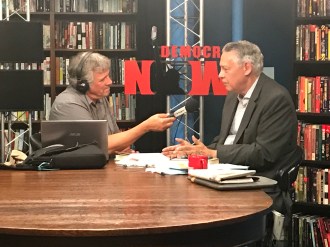 Juan González is one of the best known Latino journalists in the U.S. He has been a crusading columnist for the New York Daily News for nearly 30 years, co-host of Democracy Now! for 20 years, and is now a professor of journalism at Rutgers. His books include Harvest of Empire: A History of Latinos in America and News for All the People: The Epic Story of Race and the American Media (with Josph Torres). In his newest book,
  2017 has been an eventful year for Ken Squier: he became the first journalist ever inducted into the NASCAR Hall of Fame, he sold Thunder Road, the race track that he has owned for over a half century, and he has put his beloved WDEV radio station up for sale. In its Hall of Fame announcement NASCAR paid tribute to him: “One of NASCAR’s original broadcasters, Squier began his career with the Motor Racing Network in 1970. It was his golden voice that took NASCAR to a national audience thirsting for live coverage, giving his insider’s view of what he famously described as ‘common men doing uncommon things.’” Squier reflects on these milestones, growing up on the air, the fight to preserve independent media, what he is proudest of and his advice to young people. (July 19, 2017 broadcast)
 Vermont Conversation